
How AI Can Improve Procurement Planning for Fresh Produce Businesses
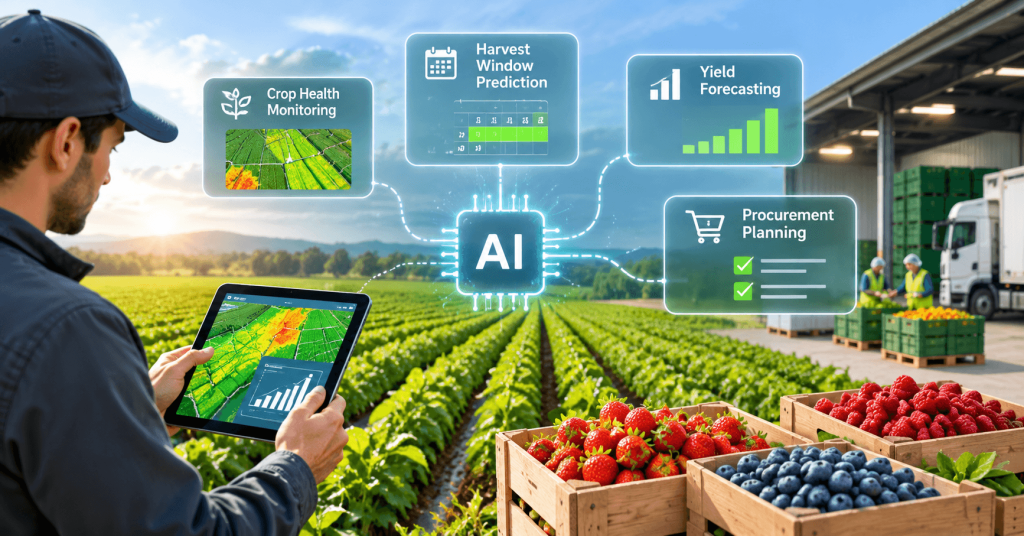
Fresh produce procurement involves more than purchasing fruits and vegetables from growers. Businesses must understand crop availability, estimate production volumes, assess quality, coordinate harvesting, and ensure that the right quantity of produce reaches packhouses or processing facilities at the right time.
However, changing weather conditions, crop health, pest and disease pressure, and unpredictable harvesting timelines make procurement planning challenging. Businesses relying mainly on historical records, manual updates and grower estimates may struggle to anticipate supply shortages or excess procurement.
Artificial Intelligence (AI) is changing how fresh produce businesses approach these challenges. By analysing satellite imagery, weather information, crop development and historical production data, AI can provide insights into potential supply availability and help businesses make more informed procurement decisions.
Key Takeaways
- AI helps improve visibility into crop conditions and potential production volumes.
- Predictive insights support better procurement and harvest planning.
- Satellite-based crop monitoring helps identify potential supply risks.
- Weather intelligence can support more informed sourcing decisions.
- Connecting farm-level intelligence with business operations improves supply planning.
1. Why Is Procurement Planning Challenging for Fresh Produce Businesses?
Fresh produce businesses often source products from multiple growers and geographical locations. They must coordinate procurement with customer orders, harvesting schedules, quality requirements, and packhouse capacity.
Some common challenges include:
Uncertain Crop Availability: Actual production may differ from initial estimates due to weather variations, crop stress, pest attacks, and other growing conditions.
Limited Grower Visibility: Businesses working with multiple growers may depend on periodic field reports, making it difficult to maintain an accurate view of crop development and expected availability.
Unpredictable Harvest Timelines: Changes in crop maturity and weather conditions can affect harvesting schedules, transportation and packhouse planning.
Quality Variations: Not all harvested produce meets buyers or export specifications. Crop conditions and maturity can influence the quality and quantity of market-ready produce.
Supply and Demand Mismatches: Overestimating availability can result in excess inventory and wastage, while underestimating supply can lead to missed orders and procurement challenges.
These challenges highlight the need for better visibility into crop conditions and potential production before harvesting begins.
2. How AI Can Improve Fresh Produce Procurement Planning
AI combines agricultural data, satellite imagery, weather information, and predictive analytics to support more informed procurement decisions.
Here are six important ways it can help.
2.1. Predicting Crop Yield and Expected Supply
AI and machine learning models can analyze satellite imagery, crop development patterns, historical yield information, and weather conditions to identify potential production trends.
This can help procurement teams:
- Estimate potential production volumes.
- Identify variations in crop development.
- Compare expected production across growing locations.
- Identify possible deviations from the planned supply.
Business impact: Better visibility into expected production helps businesses make informed sourcing decisions and prepare potential supply variations.
2.2. Monitoring Crop Health Across Grower Networks
Crop health directly influences the quantity and quality of produce available for procurement.
Satellite-based crop monitoring can provide plot-level insights into vegetation conditions, crop vigour and development patterns.
AI-powered analysis can help identify areas showing unusual crop stress, moisture-related issues, or changes in crop development.
Business impact: Procurement teams can identify growing locations that may require closer monitoring and coordinate timely follow-ups with field teams.
2.3. Improving Harvest Planning and Scheduling
Procurement teams need to coordinate crop maturity with harvesting, transportation, and receiving schedules.
AI-based crop-stage tracking and weather intelligence can help businesses understand how crops are progressing towards maturity and identify potential harvest windows.
This information can support:
- Harvest scheduling.
- Grower coordination.
- Labour and transportation planning.
- Packhouse capacity planning.
Business impact: Better visibility into potential harvest timelines helps businesses coordinate procurement and downstream operations more effectively.
2.4. Identifying Potential Supply Risks
Weather events, crop stress and pest, or disease pressure can affect expected production.
AI-powered systems can analyze weather information and crop indicators to identify potential risk signals across growing locations.
These insights can help procurement teams identify areas that may experience production variations and evaluate alternative sourcing arrangements where necessary.
Business impact: Early identification of potential supply risks gives businesses more time to review procurement plans and sourcing options.
2.5. Supporting Better Sourcing Decisions
Businesses sourcing produce from multiple farms or regions need to understand how crop conditions and potential availability differ across locations.
AI-powered crop intelligence can help compare crop development, health indicators, and expected production trends across growing areas.
This allows procurement teams to prioritise follow-ups, assess potential supply gaps, and make more informed sourcing decisions.
Business impact: Improved supply visibility supports more proactive procurement planning across grower networks.
2.6. Connecting Procurement with Packhouse and Export Operations
Procurement decisions directly influence receiving, grading, sorting, packaging, storage, and dispatch.
When businesses have better visibility into expected supply and harvest timelines, they can coordinate more effectively with packhouse and export teams.
This can support planning for:
- Expected produce arrivals.
- Packhouse capacity and labour.
- Packaging and storage requirements.
- Transportation and shipment schedules.
- Export order fulfilment.
Business impact: Connecting farm-level intelligence with downstream operations helps reduce planning gaps across the fresh produce supply chain.
3. What Data Is Required for AI-Based Procurement Planning?
AI-based procurement planning depends on relevant and reliable agricultural and operational data.
| Data Type | How It Supports Planning |
| Satellite imagery | Monitors crop conditions across growing locations |
| Crop growth stages | Provides insights into crop development and maturity |
| Historical yield data | Helps analyze previous production trends |
| Weather information | Identifies conditions that may influence crop development |
| Crop health indicators | Highlights potential crop stress and variations |
| Pest and disease risk signals | Helps identify areas requiring closer monitoring |
| Grower and farm records | Provides information about production locations and plans |
| Procurement records | Helps understand historical sourcing patterns |
Combining these data sources can provide a more comprehensive understanding of potential supply availability.
However, AI-generated insights should be validated through field observations, grower communication, and actual procurement records. Predictive estimates do not guarantee final production volumes or export-grade quality.
4. Practical Example: AI-Driven Procurement Planning for a Fresh Produce Exporter
Consider a fresh produce exporter sourcing mangoes from multiple growers across different regions.
The business needs to procure sufficient quantities to meet export orders, but variations in crop development and weather conditions make supply planning difficult.
With an AI-enabled approach, the business can:
- Monitor crop development: Use satellite-based crop monitoring to understand crop health across growing locations.
- Identify production variations: Detect areas showing unusual crop conditions or development patterns.
- Assess potential supply: Use yield trends and crop intelligence to support production estimates.
- Review harvest timelines: Use crop-stage and weather-related insights to support harvest planning.
- Coordinate procurement: Work with growers and field teams to verify crop readiness and sourcing requirements.
- Plan downstream operations: Coordinate expected supply with packhouse, quality and export teams.
This approach can help businesses move from reactive procurement towards more proactive, data-driven planning.
This is an illustrative scenario, not a verified customer case study.
5. How FarmERP and AgIntel10X Support Data-Driven Procurement Planning
Better procurement planning starts with better visibility into what is happening at the farm level.
FarmERP’s AgIntel10X is an AI-powered, satellite-based crop intelligence solution that uses satellite imagery, AI/ML models, weather intelligence and agronomic logic to provide plot-level agricultural insights.
For fresh produce exporters and agribusinesses, AgIntel10X can support procurement planning through:
- Plot-Level Crop Monitoring: Monitor crop health and vegetation conditions across growing locations.
- Crop Growth-Stage Tracking: Understand crop development patterns and support harvest planning.
- Yield Trends and Production Visibility: Gain insights into potential yield trends and variations across plots.
- Weather-Linked Risk Intelligence: Identify weather-related stress signals and potential agricultural risks.
- Supply Predictability: Understand potential supply variations and deviations from planned production.
- AI-Powered Insights: Use Balee, FarmERP’s GenAI assistant associated with AgIntel10X, to access relevant agricultural intelligence through natural-language questions.
By connecting crop-level intelligence with business operations, FarmERP helps fresh produce businesses take a more informed and predictive approach to agricultural decision-making.
Explore AgIntel10X
Conclusion
Fresh produce procurement requires businesses to manage changing crop conditions, uncertain production volumes, and unpredictable harvesting timelines.
AI offers an opportunity to improve procurement planning through crop monitoring, yield forecasting, weather intelligence, and better visibility into potential supply availability.
By combining predictive crop intelligence with field-level validation and connected business operations, fresh produce businesses can make more informed sourcing decisions and improve coordination across their supply chains.
The future of fresh produce procurement is not just about purchasing what is available today. It is about understanding what is likely to be available tomorrow.
Discover how FarmERP and AgIntel10X can support more informed, data-driven agribusiness decisions.