
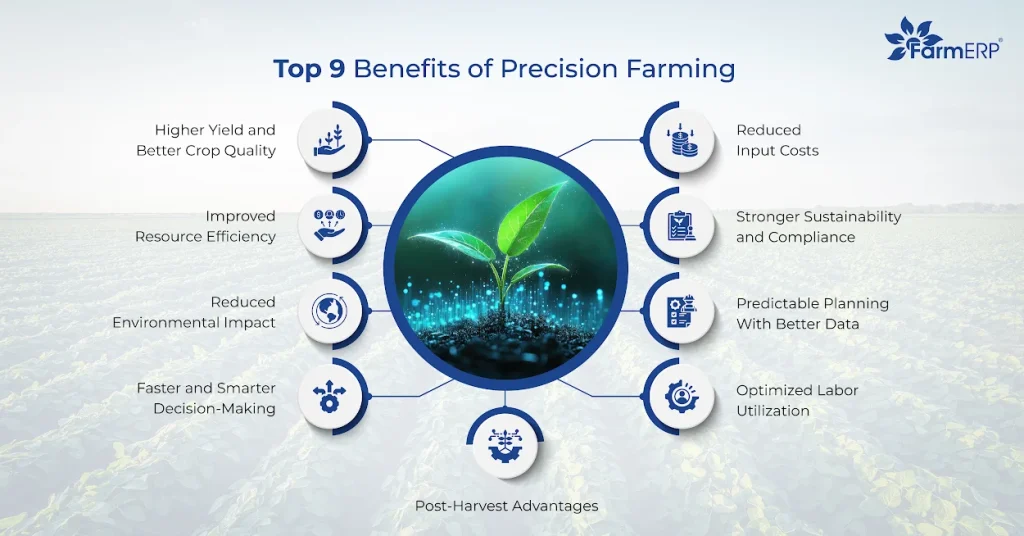
Top 9 Benefits of Precision Farming
Agriculture today demands more than manual observation and seasonal experience. Markets are volatile, input costs are rising, and climate variability continues to challenge yield stability. To stay competitive, agribusinesses are turning to data-powered methods that optimize resources, reduce waste, and improve decision-making.
That’s where precision farming delivers real, measurable impact.
By combining satellite imagery, IoT sensors, drones, analytics, and GPS-guided equipment, precision farming helps growers understand exactly what their crops need and act at the right time. Below are the top benefits of precision farming and how these practices are reshaping modern agriculture.
1) Higher Yield and Better Crop Quality
Precision farming allows growers to monitor crop development at every growth stage. With insights on plant stress, nutrient levels, and soil variability, farmers can respond proactively.
How this helps:
- Early detection of pests and disease
- Optimized fertilization schedules
- Better irrigation planning
The result is more consistent yields and higher-quality harvests across blocks and seasons.
2) Reduced Input Costs
Seeds, fertilizers, pesticides, and water are costly. Precision techniques like variable rate application ensure resources are used only where needed.
Direct benefits:
- Lower chemical usage
- Reduced fertilizer waste
- Controlled irrigation volumes
Using fewer inputs without compromising yield is one of the most impactful benefits of precision farming.
3) Improved Resource Efficiency
Water scarcity and input inflation demand smarter usage. Precision farming uses tools such as soil moisture sensors, automated irrigation, and weather data to guide exact decisions.
Growers gain:
- Precise water distribution
- Better nutrient absorption
- Reduced runoff and leaching
Resource efficiency leads to healthier crops and long-term sustainability.
4) Stronger Sustainability and Compliance
Sustainability is no longer optional. Exporters, retailers, and regulators require proof of responsible farm practices.
Precision farming helps track:
- Water consumption
- Carbon footprint indicators
- Chemical usage
- Soil health data
These records simplify audits, build buyer trust, and open premium markets, proving again the growing benefits of precision farming.
5) Reduced Environmental Impact
Traditional farming often applies uniform treatments across entire fields. Precision methods instead target only problem areas, reducing ecological stress.
This leads to:
- Lower pesticide drift
- Reduced groundwater contamination
- Decreased greenhouse gas emissions
Better management protects both the crop and the environment.
6) Predictable Planning With Better Data
Forecasting crop readiness, expected yield, and input needs is challenging without accurate field data. Precision farming delivers real-time analytics, helping agribusinesses plan ahead.
Growers can:
- Schedule harvests more accurately
- Negotiate better market prices
- Plan storage and logistics in advance
Predictability improves profitability across the chain.
7) Faster and Smarter Decision-Making
Data from drones, satellite imagery, sensors, and field observations helps identify issues before they escalate.
Decision-makers benefit from:
- Automated alerts
- Actionable recommendations
- Scouting insights
Timely action protects yield potential and reduces loss.
8) Optimized Labor Utilization
Labor shortages and rising operational costs require careful workforce planning. Precision farming tools help allocate labor precisely where it’s needed.
Examples include:
- Targeted scouting routes
- Guided harvesting activities
- Digital activity logging
Teams work more efficiently, with fewer errors.
9) Post-Harvest Advantages
Precision practices continue beyond the field. Accurate data supports:
- Better sorting and grading
- Shelf-life prediction
- Traceability documentation
- Cold chain optimization
This strengthens buyer confidence and reduces rejections.
How Technology Makes a Difference
Modern precision farming uses a connected ecosystem of tools, such as:
- Satellite imagery to monitor crop stress
- IoT sensors to track soil and weather conditions
- Drones for scouting large fields quickly
- GPS-enabled equipment for accurate planting and spraying
Together, they create actionable intelligence across the entire season.
Final Word
The benefits of precision farming are clear: higher yields, lower costs, smarter decisions, and stronger sustainability. For growers, processors, and exporters, precision agriculture turns complexity into control, making operations more resilient and profitable.
As global food demand grows and resources tighten, adopting precision farming isn’t just an advantage. It’s an essential step toward a smarter, more sustainable agricultural future.