
Understanding Post-Harvest Management and Its Importance in Modern Agriculture
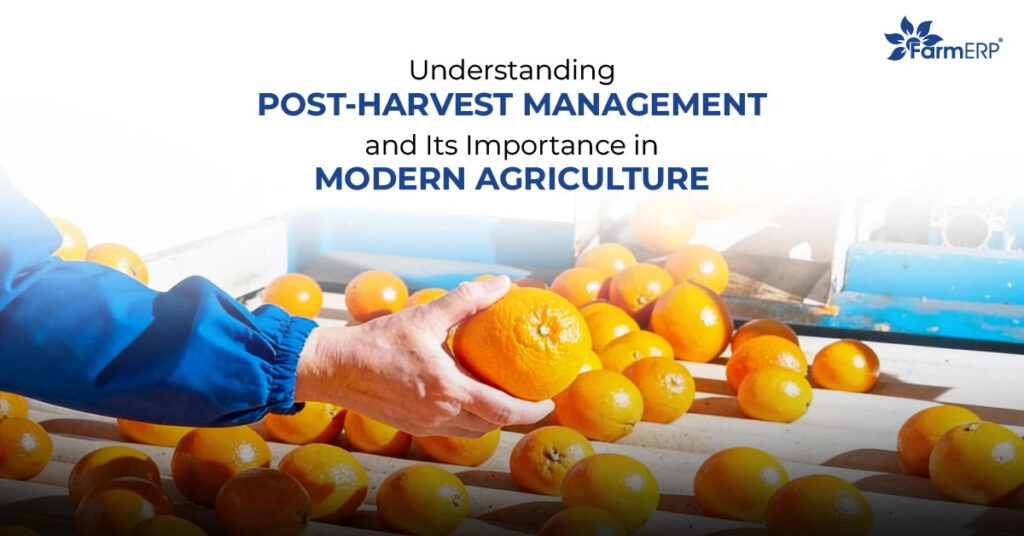
Post-harvest management refers to the handling, storage, processing, and distribution of agricultural produce after it is harvested. These post-harvest practices are critical in maintaining product quality and extending the shelf life of produce.
The journey from farm to fork involves multiple stages, such as sorting, grading, packaging, storage, and transportation, each requiring precision and care. Without proper systems in place, even the most productive farms can experience high post-harvest losses, reducing both farmer income and food availability.
Challenges in Post-Harvest Operations
Post-harvest activities face multiple hurdles that directly affect product quality and farmer profitability.
- Inadequate cold storage and poor logistics lead to faster spoilage.
- Lack of real-time visibility causes inefficiencies in inventory and dispatch.
- Manual tracking increases errors in grading, sorting, and documentation.
- Poor packaging results in contamination and product loss during transit.
These challenges make it difficult for agribusinesses to maintain consistency, meet demand, and reduce post-harvest losses.
Importance of Inventory Control, Cold Chain, and Packaging
Efficient post-harvest management is impossible without strong systems for inventory control, cold chain management, and packaging.
- Inventory Control: Monitoring stock levels and expiry timelines helps farmers and agribusinesses plan better, minimise waste, and optimise working capital.
- Cold Chain: Maintaining temperature-controlled storage and transportation is essential for preserving perishable produce and reducing microbial spoilage. Modern cold storage for farmers prevents nutrient loss and keeps food safe for longer periods.
- Packaging: Good packaging safeguards products from contamination, mechanical damage, and moisture. It also improves branding and consumer perception, which ultimately drives higher market returns.
When these three aspects work together, they not only cut down post-harvest losses but also help build resilient agri-supply chains.
Role of Technology in Post-Harvest Management
Modern technology is transforming post-harvest practices through automation and data-driven insights.
- IoT-based sensors monitor temperature, humidity, and storage conditions.
- Cloud-based systems improve coordination across supply chain partners.
- AI and analytics enable better demand forecasting and quality control.
- Digital traceability ensures compliance and quick recall management.
By integrating post-harvest technology, farms and food processors can achieve greater efficiency, transparency, and sustainability.
How FarmERP’s ProcessPack10X Helps
At FarmERP, we have designed ProcessPack10X to strengthen every stage of post-harvest management. From post-harvest technology integration to cold storage for farmers, our solutions help reduce post-harvest losses and improve product quality at scale. Here’s how:
1. Smart Planning and Resource Management
Our system prevents material shortages and production halts by enabling accurate forecasting and resource allocation. With intelligent scheduling, agribusinesses can optimise workflow and maintain steady production without disruptions.
2. Real-Time Analytics and Insights
ProcessPack10X delivers real-time data and performance dashboards for agile decision-making. Managers can instantly track operations, identify inefficiencies, and take corrective action before they impact output.
3. Automated Quality Control
Built-in quality control mechanisms reduce batch rejections and packaging errors. Each stage of processing is monitored with precision, ensuring that only compliant and high-quality products reach the market.
4. Complete Traceability and Faster Audits
We ensure 100% product traceability from harvest to dispatch. With 90% faster audits and recall responses, our users experience improved compliance and quicker resolution of quality issues.
5. Cold Chain and Temperature Monitoring
The platform offers full control over temperature-sensitive operations such as packing, storage, and transportation. Continuous monitoring prevents spoilage and helps maintain optimal product freshness.
6. Cost and Loss Reduction
ProcessPack10X helps achieve up to 20% cost savings through inventory optimisation and accurate valuation. It also reduces operational losses by up to 10%, directly improving profitability.
With ProcessPack10X, we help agribusinesses gain full control, cut operational losses, and deliver products faster with assured quality.
Conclusion
Effective post-harvest management is not just about preventing losses; it’s about creating value across the entire agricultural supply chain. By adopting advanced post-harvest practices, farmers and agribusinesses can deliver fresher, safer, and more profitable produce to the market. With the integration of technology, the agricultural sector is moving towards a future of precision, efficiency, and sustainability.
We at FarmERP are pioneers in digital agriculture solutions, empowering agribusinesses with data-driven insights, automation, and traceability. Our mission is to help the global agriculture ecosystem become more efficient, sustainable, and profitable through technology-driven innovation.